

The afternoon sun was hot on County Road 6.
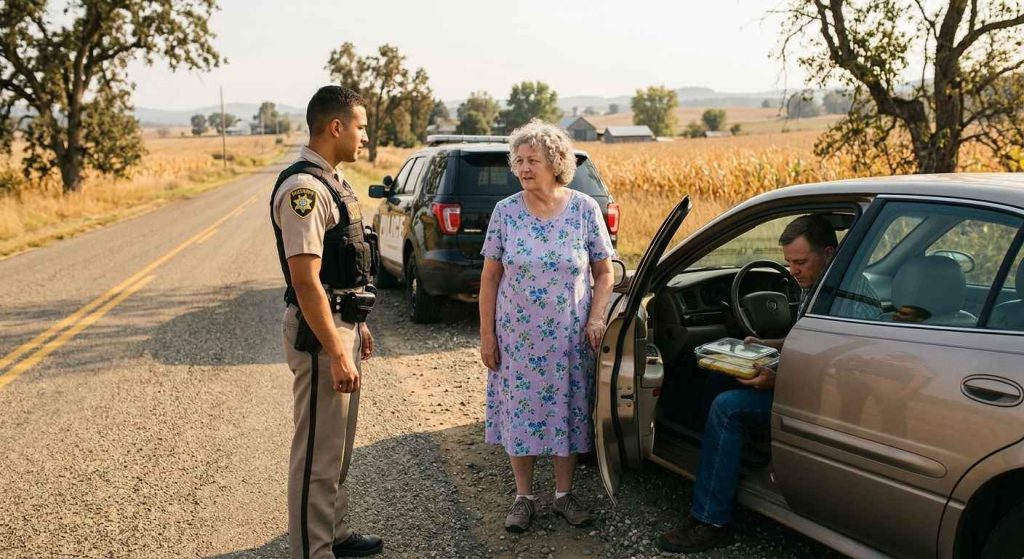
My 71-year-old mother, Shirley Hagen, stood beside her Buick in a simple flowered Sunday dress. She was waiting for a young deputy to finish questioning her.
We had only been on the road for a few minutes when he stopped us.
He said there was something wrong with my mother’s temporary driver’s license. He believed it looked unusual, even though Shirley had recently renewed it at the courthouse.
She calmly explained that the paperwork was legitimate.
But the deputy did not seem convinced.
He asked Shirley to get out of the car.
Then he left her standing beside the road while he returned to his air-conditioned patrol vehicle.
I was sitting in the passenger seat, holding a pan of lemon bars that we were taking to our church’s ice cream social.
I watched my mother standing in the heat and felt helpless.
“Officer, she’s 71,” I said. “Can’t she wait somewhere cooler?”
He looked at me and told me to stay quiet.
My mother gently shook her head.
“It’s okay,” she said. “I can handle this.”
So I stayed beside her.
The minutes passed.
The sun became hotter.
My mother tried to remain calm, but I could see that she was uncomfortable.
After a while, the deputy came back.
Instead of simply explaining what was happening, he questioned her memory and made comments about her age.
Then he told her that he planned to issue tickets and have her Buick towed.
I expected my mother to become angry.
She didn’t.
Instead, she looked at him for a moment and made an unusual request.
“Would you do something for me?” she asked.
The deputy looked confused.
“What?”
“Say my name over the radio.”
He seemed to think it was funny.
But he agreed.
He picked up his radio and said, “Shirley Hagen would like her name announced.”
He waited for a response.
At first, there was silence.
Then the dispatcher asked him to repeat the name.
He did.
A few seconds later, another voice came over the radio.
“Shirley?”
Then another.
And another.
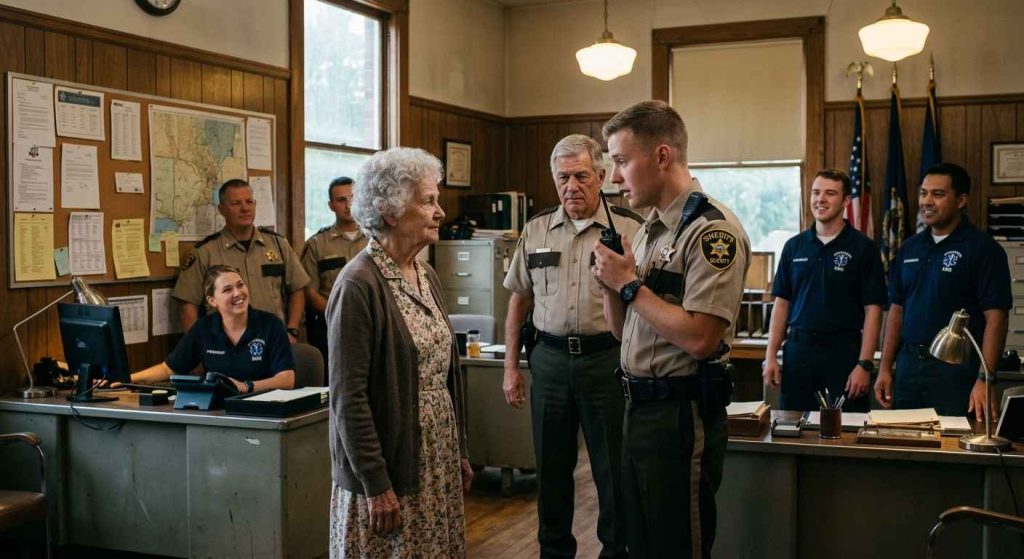
Soon, several people were responding.
Deputies.
Firefighters.
Medical workers.
Even a state trooper.
They all seemed to know my mother.
I looked at Shirley.
She simply stood there, quietly listening.
The young deputy’s attitude began to change.
He had clearly expected a joke.
Instead, he had just introduced himself to a woman many people in the county respected.
Then the sheriff came over the radio.
“Shirley Hagen?” he asked.
“Yes,” my mother replied.
The sheriff then asked the deputy an important question.
“How long has she been standing out there?”
The deputy said nothing.
The sheriff asked again.
Finally, the deputy admitted that Shirley had been standing in the heat for about 40 minutes.
The sheriff’s voice became serious.
“I’m on my way.”
The radio went quiet for a moment.
Then another voice came through.
It belonged to a man named Walt Brandt.
He was the young deputy’s father.
Walt knew Shirley very well.
He explained that years earlier, Shirley had worked as a dispatcher for the Kessler County Sheriff’s Office.
She had spent 34 years working overnight shifts, answering emergency calls and helping people during some of the hardest moments of their lives.
One night, Walt had been involved in a serious farm accident.
A tractor had trapped him.
He was frightened and struggling to stay calm.
Shirley stayed on the phone with him for 51 minutes.
She kept him talking while help was on the way.
She asked him about his young son, Kyle.
That helped Walt stay focused until rescuers arrived.
The young deputy finally understood something.
His father had once depended on the same woman he had just treated with so little patience.
When Sheriff Tom Hanley arrived, he spoke with the deputy.
The sheriff did not fire him.
Instead, he gave him a different assignment.
For the next month, Kyle would work overnight in the dispatch room.
He would listen to emergency calls and learn what people sounded like when they were scared, confused, or desperate for help.
Shirley did not ask for punishment.
She asked the sheriff to let the young deputy learn from the experience.
“He needs to understand what people are going through,” she said.
That decision stayed with me.
That evening, I took my mother’s old headset to the dispatch center.
I watched Kyle begin his first night there.
As I listened to the emergency calls, I realized something I had never fully understood.
For most of my life, I had described my mother’s job as simply answering phones.
I had never thought about what those calls really meant.
Behind every call was a person who needed help.
Someone might be trapped.
Someone might be frightened.
Someone might not know what to do.
And Shirley had spent decades being the calm voice on the other end of the line.
She had helped people find their way through some of their darkest moments.
She had even helped the sheriff deliver his daughter during a snowstorm.
She had guided a farmer to safety.
She had supported countless first responders.
Yet she had never talked much about any of it.
A few weeks later, Kyle visited my mother.
He apologized.
Then he told her that the month in dispatch had changed the way he looked at his job.
He said he now understood that every person he stopped on the road was someone with a story.
My mother smiled.
She didn’t lecture him.
She simply said, “Just remember to treat people the way you would want someone to treat your family.”
Her new driver’s license eventually arrived.
But Shirley never made a big deal about what had happened on County Road 6.
She went back to her normal life.
She listened to the scanner.
She worked in her garden.
She went to church.
And she kept helping people in the quiet ways she always had.
But something changed for me.
I started calling my mother every Sunday night.
Before that day, I had often been busy with my own life.
I had never stopped to think about how much she had done for other people.
Now I understood.
My mother had spent 34 years answering calls from people who needed someone.
And somehow, she had never asked for much in return.
That is why I call her every Sunday.
And every time the phone rings, she answers on the first ring.
Sometimes she doesn’t even say hello.
She just says, “I was wondering when you’d call.”
And I smile.
Because after all those years of my mother answering everyone else’s calls, I finally understood something simple:
The woman who spent her life being there for others deserved to know that someone would always be there for her, too.
0 Comments