

Her Teacher Threw Her Hero Report in the Trash—Then Her Dad Walked Into the Classroom With Scout
Clara Reed was only eight years old when her teacher threw her school project into the trash in front of the entire class.
She had spent two weeks working on that report. She had written about her father, Staff Sergeant Ben Reed, and his military working dog, Scout. She had checked her spelling, corrected her mistakes, and carefully drawn a picture of the dog she admired so much.
But her teacher, Ms. Harrow, refused to believe her story.
She picked up Clara’s blue folder, walked across the classroom, and dropped it into the trash can.
Then she handed Clara a small yellow note.
“Come to the front and read this to the class,” she instructed.
Clara’s hands trembled as she unfolded the paper.
The note said, “I am sorry I gave the class information I could not prove.”
Clara looked at the trash can. A corner of her blue folder was still visible above the other papers.
Inside it were her drawings, her handwritten notes, and everything she had learned about her father’s work.
She wanted to cry, but she remembered something her father had once told her.
“Being brave doesn’t mean you aren’t scared. It means you keep going even when you are.”
So Clara stood in front of her classmates and read the note.
She had no idea that her father would soon walk through the school doors with Scout—and give her a moment she would remember for the rest of her life.
The Assignment That Meant Everything to Clara
Two weeks earlier, Ms. Harrow had given the class a project called “Real-Life Hero Report.”
Each student had to choose someone who helped others, interview that person, write a report about their work, and include a drawing. The best projects would be displayed on the classroom’s Hero Wall.
Clara knew immediately who she wanted to choose.
Her father.
Staff Sergeant Ben Reed was a Marine Corps military working dog handler. His working partner was Scout, a Belgian Malinois trained to help detect dangerous items and support his handler during their duties.
Clara had met Scout several times. She knew he was more than an ordinary pet.
Whenever she visited her father, Ben reminded her to respect Scout’s work.
“He’s working, Clara,” he would tell her. “Always ask before approaching him.”
Clara understood. She admired the way her father cared for Scout and how carefully the two worked together.
To her, they were a team that trusted each other completely.
She couldn’t think of anyone better for her school project.
Clara Learned Everything She Could About Scout
Because her father was away on duty, Clara interviewed him through video calls.
The connection wasn’t always reliable. Sometimes the screen froze in the middle of an answer. Other times, the call ended before she could finish asking her questions.
But Clara never gave up.
She kept a notebook beside her computer and wrote down everything her father explained.
“What happens when Scout finds something dangerous?” she asked during one conversation.
Ben explained that Scout was trained to give a passive alert. Rather than barking or scratching at the location, he would sit quietly to indicate that he had detected something.
Clara listened carefully and wrote the information in her own words.
She learned about the training military working dogs receive, the tests they must pass, and the special relationship they develop with their handlers.
Then her father shared a detail that made her laugh.
“There’s an old military tradition that working dogs are sometimes treated as one rank higher than their handlers,” Ben explained.
Clara stared at the screen.
“Wait. Does that mean Scout outranks you?”
Ben laughed.
“According to that tradition, yes.”
Clara immediately wrote the answer in large letters across her notebook.
SCOUT OUTRANKS MY DAD!
It became her favorite part of the entire report.
For Clara, the project wasn’t just another school assignment. It was a chance to show her classmates what made her father special and why she was so proud of him.
Two Weeks of Hard Work
Over the next several evenings, Clara worked carefully on her report.
She checked every sentence, corrected spelling mistakes, and reviewed her notes whenever she wasn’t sure about a detail.
She also drew a picture of Scout.
She remembered the dog’s dark face, pointed ears, and alert expression. She even included the small scar above his ear that her father had once explained to her.
When the report was finally finished, Clara placed everything inside a blue folder.
On the front, she wrote:
MY REAL-LIFE HERO:
STAFF SERGEANT BEN REED AND MWD SCOUT
She looked at the finished project and smiled.
She imagined her classmates asking questions. She pictured her report hanging on the classroom wall, where everyone could see it.
Most of all, she imagined telling her father that she had done a good job.
She couldn’t wait for presentation day.
The Presentation Took an Unexpected Turn
When her turn arrived, Clara walked to the front of Room 3B with her blue folder held against her chest.
She opened it and began reading.
“My real-life hero is my dad…”
She described his job and explained how Scout helped him. She talked about their training, their teamwork, and the importance of trust between a handler and a working dog.
For the first few minutes, everything went as planned.
Then Ms. Harrow interrupted.
“Where did you learn all of this?” the teacher asked.
“My dad told me,” Clara replied.
“You interviewed him?”
“Yes. We talked on video calls.”
“And you wrote this yourself?”
Clara nodded. She even showed the teacher her handwritten notes.
But Ms. Harrow remained unconvinced.
She believed some of the information could not be verified and decided Clara’s report was unsuitable for the Hero Wall.
She wrote two words across the front of the folder:
NOT VERIFIED
Then she told Clara to return to her seat.
Clara felt her excitement disappear.
She had done exactly what the assignment required. She had interviewed someone, taken notes, researched the subject, and prepared a drawing.
Yet she was being treated as though she had made everything up.
She sat down quietly, trying to understand what had gone wrong.
Clara’s Mother Tried to Clear Up the Misunderstanding
When Clara arrived home, she told her mother, Lauren, everything that had happened.
Lauren was upset, especially when she saw how disappointed her daughter was.
Still, she decided to approach the situation calmly.
She contacted Ms. Harrow and explained that Clara really had interviewed her father. She offered to provide photographs, information from his unit, and an opportunity to speak with Ben directly.
She wasn’t asking the teacher to give Clara special treatment.
She simply wanted her daughter’s work to receive a fair review.
But the following morning, things became even more painful.
In front of the class, Ms. Harrow picked up Clara’s blue folder.
She explained that students needed to provide information that could be supported before it could be accepted.
Then she walked to the trash can.
And dropped Clara’s project inside.
The room became quiet.
Clara stared at the folder as it disappeared beneath the other papers.
Her teacher handed her the yellow note and instructed her to read it aloud.
Clara did as she was told.
Her voice was small, and she struggled to hold back her tears.
When she finished, she returned to her desk.
She felt embarrassed, hurt, and confused. She had told the truth, yet she had been made to apologize for it.
Then something unexpected happened.
A boy named Mateo leaned toward her and whispered, “I believe you.”
It was only four words, but Clara needed to hear them.
For the first time that morning, she felt a little less alone.
She Returned for the Folder
After school, Clara went back to the classroom.
She couldn’t stop thinking about her project. Even though it had been thrown away, she wanted to bring it home.
She found the blue folder inside the trash can.
It was bent, and pencil shavings had fallen across the pages. Part of her drawing had been crumpled.
Carefully, she lifted it out.
The school custodian, Mr. Okafor, noticed her standing beside the bin.
“Are you looking for something?” he asked.
“My report,” Clara answered. “I made it about my dad and his dog.”
Mr. Okafor helped her clean the folder. As he looked at the drawing, he recognized the breed.
“That’s a Belgian Malinois,” he said.
Clara looked up in surprise.
Mr. Okafor explained that he had worked around military dogs many years earlier. He understood that working dogs required training, patience, and a strong bond with their handlers.
Before Clara left, he offered her some advice.
“Something true doesn’t stop being true just because someone doesn’t believe it.”
Clara held her folder a little more tightly.
She didn’t know how to fix what had happened at school, but she remembered his words.
She took the damaged project home.
A Phone Call Changed Everything
That evening, Clara and her mother called Ben.
When he saw his daughter’s wrinkled folder, his expression changed.
Lauren explained what had happened, from the teacher’s questions to the note Clara had been forced to read.
Ben listened without interrupting.
Then he turned his attention to his daughter.
“Dad, I told the truth,” Clara said quietly. “But nobody believed me.”
Ben looked at her through the screen.
“You did your best,” he assured her. “You interviewed me, you took notes, and you worked hard on that report. I’m proud of you.”
Clara wiped her eyes.
Her father paused before adding something she would remember for years.
“Sometimes the truth needs help getting through the door.”
Then Ben began thinking about what he could do.
He contacted his unit and asked whether he could return home early to visit Clara’s school with Scout. After the necessary arrangements were made, the visit was approved.
Ben wasn’t planning to argue with the teacher or embarrass anyone.
He wanted to give Clara the chance to finish what she had started.
He wanted her classmates to learn about military working dogs from someone who worked with them.
And he wanted his daughter to know that she deserved to be heard.
The Morning Scout Walked Into Room 3B
The next morning, Clara arrived at school with her parents.
But this time, she wasn’t carrying her blue folder alone.
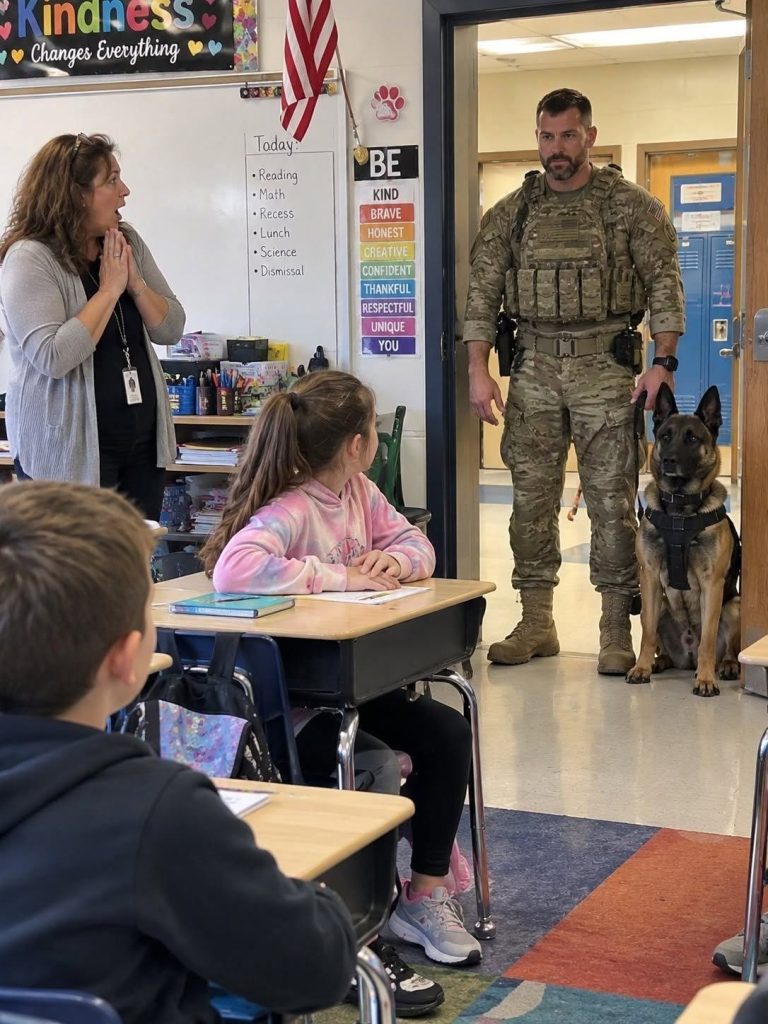
Her father was beside her, and Scout was with him, wearing his working vest.
As they entered Room 3B, the students noticed the dog almost immediately.
Conversations stopped.
Several children leaned forward in their seats.
Ms. Harrow looked toward the doorway.
There stood Staff Sergeant Ben Reed in uniform, with Scout calmly beside him.
Clara felt her heart beating faster.
The same dog she had described in her report was standing right there in front of her classmates.
The scar above his ear was visible, just as she had drawn it.
Ben introduced himself and explained that he had come to give the students a short presentation about military working dogs.
He spoke about Scout’s training, the responsibilities of a handler, and the importance of following safety instructions around working animals.
He answered the children’s questions and explained that Scout’s job required concentration, practice, and teamwork.
Throughout the visit, Ben remained calm and respectful.
He didn’t criticize Ms. Harrow in front of the students.
He didn’t demand that anyone admit they were wrong.
Instead, he asked for one simple thing.
“Would it be possible for Clara to finish her report?”
The teacher agreed.
Clara walked to the front of the classroom with her damaged blue folder in her hands.
This time, Scout stood beside her.
Clara Finally Finished Her Presentation
Clara opened the folder.
Some of the pages were still bent, and the edges of her drawing were wrinkled. But she didn’t mind.
She began reading again.
“My real-life hero is my dad…”
She explained his responsibilities and described the work he and Scout did together. She talked about the training, the passive alerts, and the trust required between a handler and his dog.
She also showed the class her drawing.
Then she reached the part she had been most excited about before everything went wrong.
“There’s an old tradition that military working dogs are sometimes considered one rank higher than their handlers,” she said.
She looked at her father.
“So Scout outranks my dad!”
The students laughed.
Ben smiled.
“That’s right,” he replied. “According to that tradition, Scout is my boss.”
At that moment, Scout gave a short bark.
The room filled with laughter.
Clara laughed too.
For the first time in two days, she no longer felt embarrassed about her report.
She felt proud.
Her father was there. Her classmates were listening. And the story she had worked so hard to tell was finally being heard.
The Teacher Admitted Her Mistake
After the presentation, Ms. Harrow stood before the class.
She acknowledged that she had made a mistake.
She had questioned Clara’s report without properly checking the information, and she had handled the situation in a way that hurt a student who had worked hard and tried to follow the assignment.
Then she turned to Clara.
“I’m sorry,” she said. “You told the truth, and I should have listened before making a judgment.”
Clara didn’t give a long response.
She simply accepted the apology.
Ms. Harrow picked up the report and looked at the words she had written on the front.
Beneath NOT VERIFIED, she added a new note:
VERIFIED IN PERSON BY STAFF SERGEANT BEN REED AND MWD SCOUT.
Then she placed Clara’s report on the classroom’s Hero Wall.
Not in a corner.
Not behind someone else’s project.
She placed it right in the middle, where everyone could see it.
The class applauded.
Clara looked at the report, then at her father.
Ben gave her an encouraging smile.
She finally had the moment she had imagined when she first started the assignment.
But it meant even more now.
Why Clara Kept the Damaged Folder
Later, Clara was offered the chance to make a clean copy of her report.
She could have replaced the wrinkled pages, redrawn Scout, and started again.
But she decided to keep the original.
The blue folder was still bent. There were pencil marks on the pages and a small stain from the trash.
To someone else, it might have looked like a damaged school project.
To Clara, it meant something different.
It reminded her how hard she had worked, how painful it felt when someone refused to believe her, and how much a few kind words could matter.
It reminded her of Mateo, who had quietly said, “I believe you.”
It reminded her of Mr. Okafor, who had encouraged her not to give up.
Most of all, it reminded her of her father, who had shown her that a person could stand up for what was right without humiliating someone else.
Clara didn’t want to forget any of that.
So she kept the folder exactly as it was.
The Lesson Clara Carried Into the Future
Years later, Clara still remembered the day her father walked into Room 3B with Scout.
She remembered the nervous feeling in her stomach when she first stood in front of the class.
She remembered looking at her work in the trash and wondering why telling the truth hadn’t been enough.
But she also remembered the moment everything changed.
Her father hadn’t arrived to fight with her teacher. He had arrived to support his daughter, share his experience, and help her finish the story she had started.
Clara learned that people can make mistakes, even when they believe they are doing the right thing.
She learned that asking questions and checking information are important, but so is treating others with fairness and kindness.
And she learned that one person’s refusal to believe you doesn’t automatically make your words untrue.
Sometimes, what you need most is someone willing to listen.
For Clara, that person was her father.
And standing proudly beside him was Scout, the loyal military working dog who had helped turn one of the hardest days of her childhood into a memory of courage, love, and second chances.
Because the real lesson wasn’t that Clara had won an argument. It was that she had been given the chance to tell her story—and the courage to finish it.
0 Comments