

The Day My Mother-in-Law Tried to Take My Baby — And How I Fought Back
At eight months pregnant, I finally thought I had reached a place of peace. After years of longing and planning, my life felt steady, balanced—almost perfect.
The house smelled faintly of lavender from the diffuser in the corner. In the nursery, soft yellow curtains swayed gently whenever the fan turned, and I would spend hours folding and refolding tiny onesies, pressing the soft cotton against my cheek as if memorizing the scent of the baby I hadn’t met yet.

This was everything I had worked for: a home, a loving marriage, and soon, a family of my own.
Or so I believed.
The Day Everything Changed
Jacob, my husband, had always been close to his mother. At first, I found it sweet—she had raised him alone, and he was her only child. But as time passed, I realized their bond wasn’t just close. It was… tethered. Her opinions controlled his moods, her needs shaped his decisions, and no matter how hard I tried, I never felt like I was fully part of the equation.
I told myself fatherhood would change things. I imagined the nursery, which I had poured my heart into—hand-painting tiny foxes and owls on the walls despite my aching back, choosing soft forest-themed décor, dreaming of our baby’s first steps into that room. I believed this space would mark a shift in our lives, a boundary he would finally set with her.
But one ordinary afternoon, my fragile sense of security shattered.
I returned home from my weekly prenatal appointment, exhausted but relieved. When I opened the front door, the sound of furniture scraping across hardwood echoed through the house, followed by Jacob’s voice giving instructions.

I stepped into the hallway—and froze.
The crib was gone. The rocking chair—the one I had imagined cradling my newborn in—was being carried out by two deliverymen. My mural, the hours of detail I’d painted, was hidden behind stacks of cardboard boxes. And there, at the center of the chaos, stood Jacob, sweaty, awkward, and clutching a roll of packing tape like it could justify what he’d done.
“What’s happening?” My voice cracked as my chest tightened.
He avoided my gaze. “I should’ve told you sooner… Mom’s been really down lately. Lonely. Depressed. I thought… maybe she could stay here for a while. Just until she feels better.”
I blinked, stunned. “You gave away our baby’s nursery… to your mom?”
“She needs us,” he said, his voice almost pleading. “She’s been crying on the phone every night. I couldn’t just ignore her.”
I placed both hands on my swollen belly, instinctively protective. “Jacob, I’m due in a month. Where is our baby supposed to sleep?”
“It’s temporary,” he said quickly. “And Mom says she’ll help with the baby. It’ll actually make things easier.”
Easier.
Nothing about this felt easy.

I walked away without another word, shutting myself in our bedroom as silent tears burned my cheeks. The life I thought we were building suddenly felt fragile, invaded.
The Conversation I Wasn’t Supposed to Hear
That night, I passed the nursery on my way to the kitchen and stopped when I heard voices inside.
“Do you really think she bought it?” My mother-in-law’s voice was sharp, laced with smugness.
Jacob hesitated. “She’s upset, but… she’ll come around. She doesn’t want to stress the baby.”
Her low, satisfied chuckle sent chills down my spine.
“Good. Because once the baby is here, things will change. I’ll be the one setting the rules, not her. She has no idea how much influence I’ll have living under this roof.”
My pulse pounded in my ears.
“She’s too naïve,” she continued. “She thinks she’s in charge because she painted some animals on the wall. Please. That nursery is mine now—and when the baby comes, so is the baby.”
I gripped the doorframe, the glass of water in my hand trembling.
This wasn’t about loneliness. It wasn’t about helping. It was a plan—a calculated attempt to claim my sanctuary, my authority, and even my child.
A Silent Promise
I didn’t confront them that night. I lay awake instead, one hand resting protectively on my belly, whispering silent promises to the baby inside me:
“I will protect you. No one will take you from me.”
The next few days, I played my part. I smiled when she mentioned “her room.” I nodded when Jacob praised her willingness to “help.” But inside, my resolve hardened with every smirk, every passive-aggressive remark about “new mothers not knowing what they’re doing.”
I started watching. Waiting. Planning.
The First Battle
One evening, while Jacob worked late, I walked past the nursery and stopped cold.
She was inside, folding the baby clothes I had bought, carefully placing them into drawers she had rearranged without my consent.
“You won’t be needing these, dear,” she murmured softly, holding up a tiny onesie. “Not when I’ll be the one raising you.”
I stepped back before she saw me, bile rising in my throat. I knew then that if I confronted her too soon, Jacob would defend her. I had to wait until the right moment.
The Birth of My Daughter
Labor came early. The contractions hit hard and fast, and Jacob rushed me to the hospital—with his mother trailing close behind.
Hours later, through exhaustion and tears, my daughter arrived.
The moment she was placed in my arms, I felt a shift deep within me. Whatever doubts, fears, or compromises had existed before vanished in an instant. This child was mine. And I would not let anyone take her.
The Night I Stood My Ground
The first week home blurred together in a haze of feedings and sleepless nights. His mother hovered constantly, inserting herself into every decision—how to swaddle, when to feed, what brand of diapers to use.
One night, barely a week postpartum, I woke to faint footsteps. I followed them to the nursery—and froze in the doorway.
She was rocking my baby in the chair I had picked out, whispering softly:
“Don’t worry, sweetheart. Grandma’s here. I’ll raise you the right way. You’ll love me more than her.”
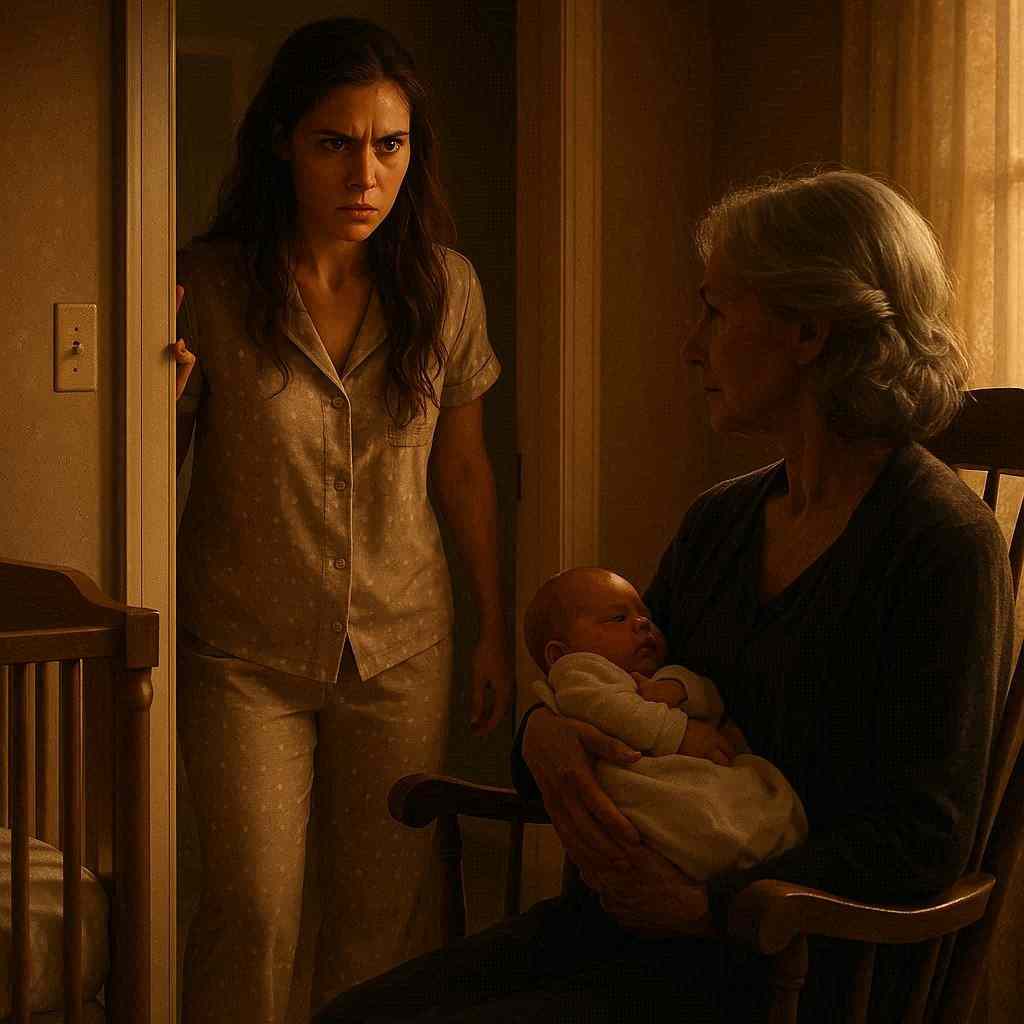
A cold fury surged through me. “Put her back,” I said, my voice steady but sharp.
Startled, she turned with a smirk. “You should rest, dear. Let me take her tonight.”
“No,” I said firmly, stepping into the room. “She’s my baby. Not yours.”
She scoffed. “You can’t do this alone. Jacob knows that. That’s why I’m here. You should be grateful.”
I met her gaze, fire in my chest. “Grateful? You took my nursery, invaded my space, and now you’re trying to take my child? Never.”
Her expression faltered for the first time.
I took my daughter gently from her arms and walked out without another word.
The Truth Finally Comes Out
That night, I told Jacob everything—the conversation I overheard, her plan, the way she whispered claims of ownership over our baby.
For the first time, he didn’t defend her. He looked pale, guilty, shaken.
The next few weeks weren’t easy. There were arguments, tears, and long nights where I wondered if our marriage could survive. But slowly, Jacob began to see the truth. The manipulation. The lies. The control.
Within a month, she was moved out.
The nursery became ours again, finally filled with the peace and purpose I had dreamed of.
What I Learned
Even now, when I watch my daughter sleep, I sometimes think back to the moment I stood outside that nursery door, listening to her plan. A shiver runs through me—but then I remember the promise I made the night she was born.
I will protect her. Always.

I learned that becoming a mother doesn’t just mean nurturing—it means defending. It means standing your ground, setting boundaries, and refusing to let anyone take what is yours.
Because here’s the truth no one can rewrite:
I am her mother.
And that is a power no one can ever claim.
0 Comments